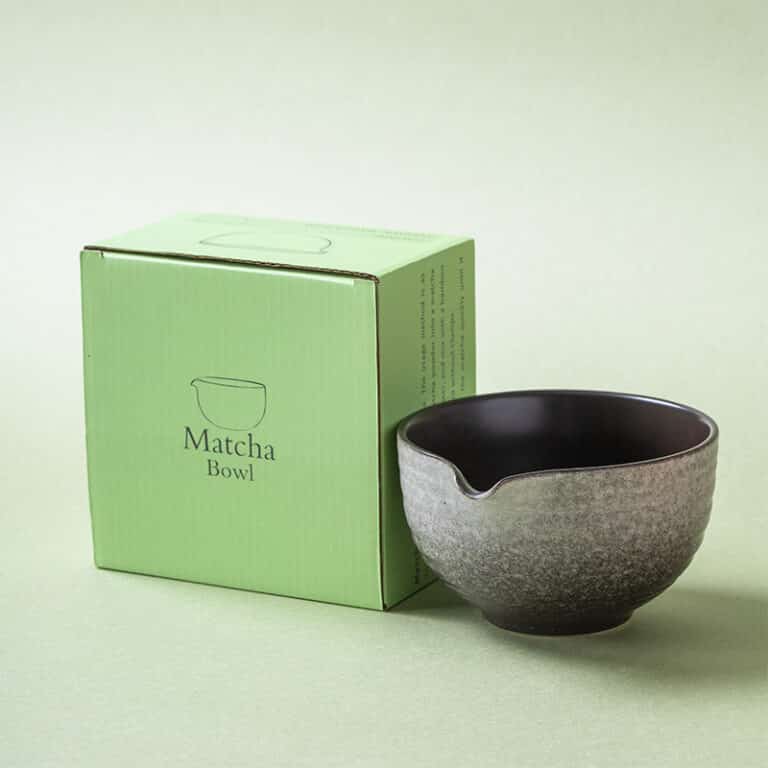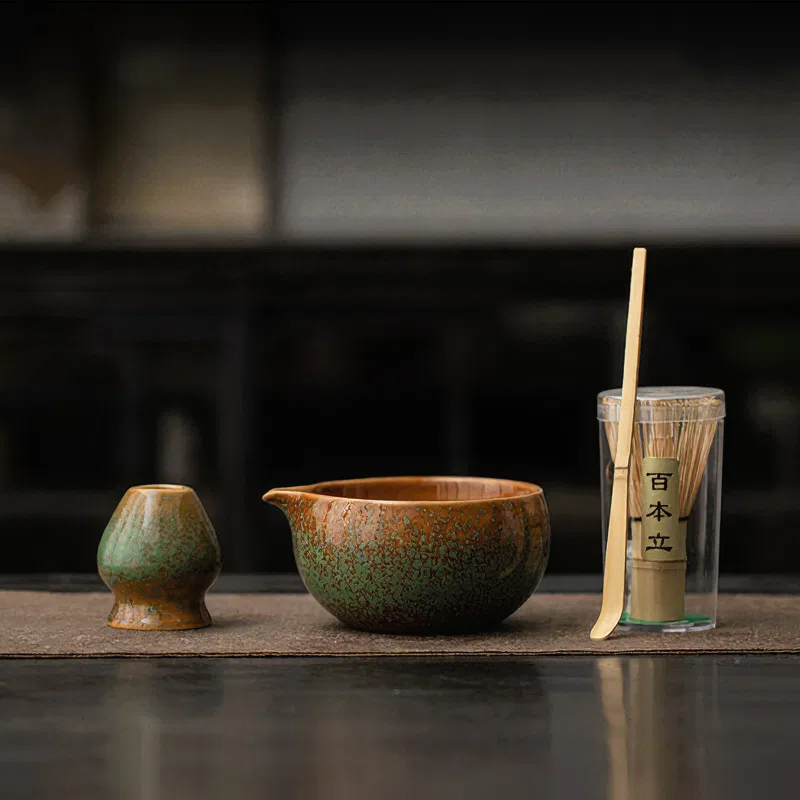
The glaze on this set has a name in Japanese ceramic tradition: yohen, meaning kiln-change. It refers to surfaces where the firing process itself, temperature, atmosphere, flame direction, the precise position of the piece in the kiln, produces colour and texture that the potter guides but cannot fully predict. Yohen glazes have been prized in Japanese chado (the way of tea) for centuries precisely because of this unpredictability: the result is a surface that could only have come from fire, and that no two firings will exactly repeat.
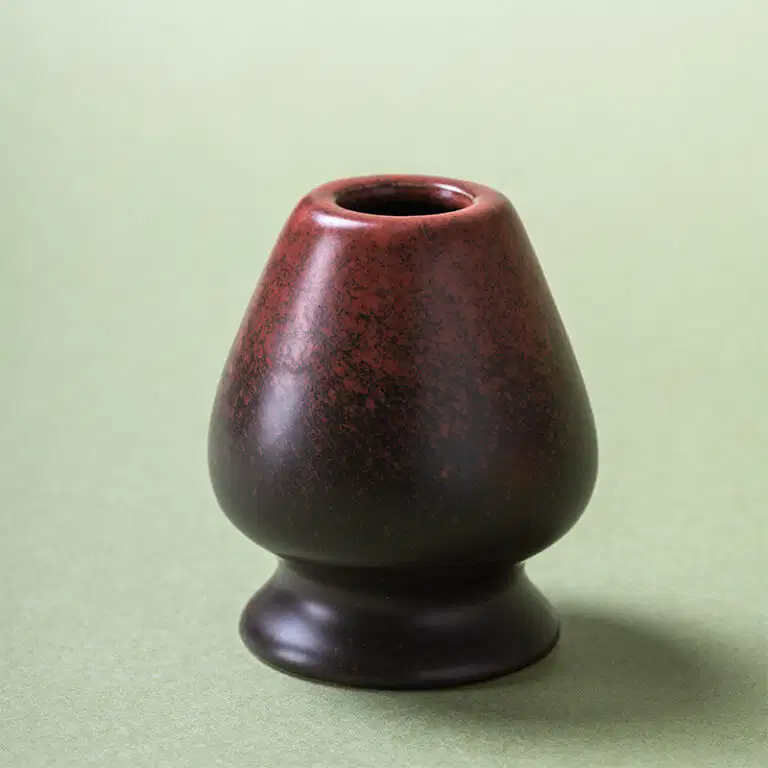
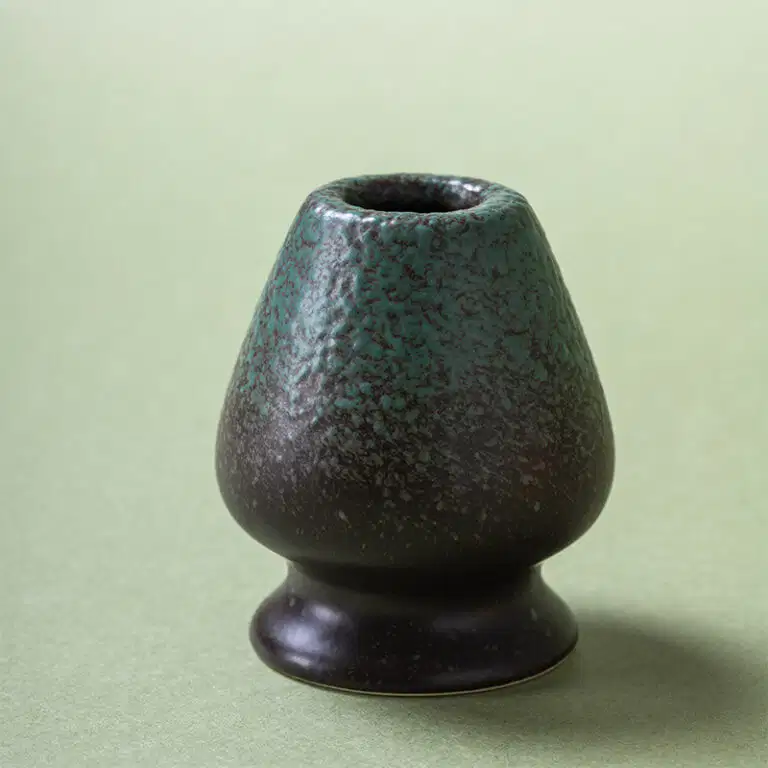
On this set, the yohen glaze produces a warm amber and russet at the rim and upper body of the chawan, the colour of oxidised copper, or of autumn bracken, that transitions through a dense, volcanic speckle to a deeper forest green at the base. The speckled mid-zone, where the two colours meet, has a complex, almost mineral quality: pools of green breaking through the amber ground like patina forming on old bronze. The chasen holder carries the same glaze in concentrated form, the green more dominant at the base, the amber catching at the shoulder.
The glaze tradition:
The yohen kiln-change effect places this set within one of the most celebrated lineages in East Asian ceramics. The most famous yohen pieces — the tenmoku (temmoku) tea bowls of Song Dynasty China, with their oil-spot and hare’s-fur glaze effects, were brought to Japan by Zen monks in the 12th and 13th centuries and became among the most treasured objects in Japanese tea culture. Several are designated National Treasures of Japan. This copper-green yohen sits in a different part of that tradition, closer to the iron-copper glazes of Oribe ware, developed during the Momoyama period in the late 16th century under the aesthetic influence of tea master Sen no Rikyu — but it shares the same underlying principle: beauty that comes from the honest behaviour of materials under heat.
What is included:
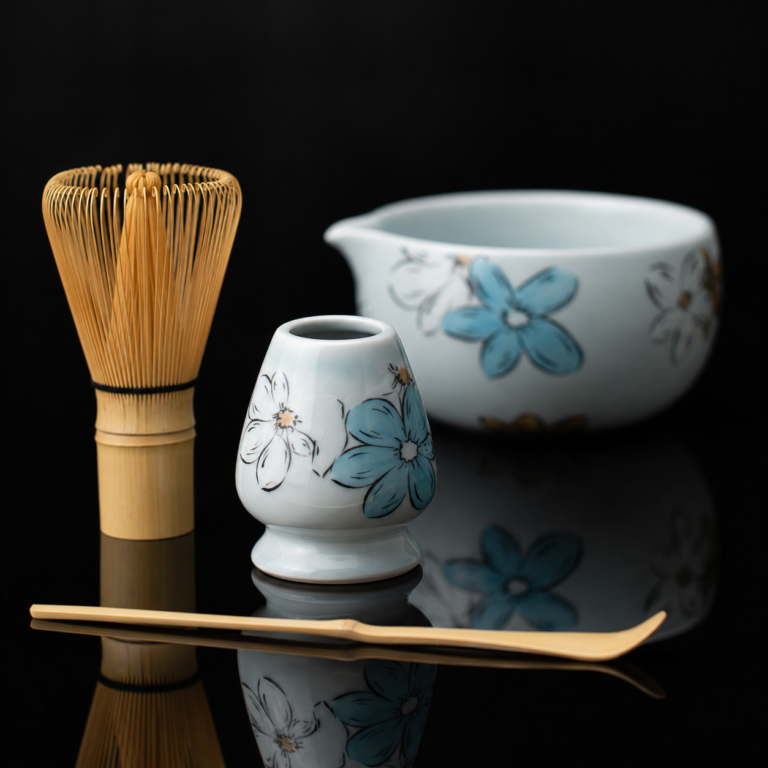
Chawan (matcha bowl): Wide-mouthed stoneware in the yohen copper-green glaze, proportioned for confident whisking and deep enough for both usucha (thin matcha) and koicha (thick matcha). A small pouring spout is cut into the rim. The interior is smooth, providing a clean surface against which the vivid green of ceremonial-grade matcha reads clearly. The kodai (foot ring) is hand-finished, with the natural irregularity of a piece shaped by hand.
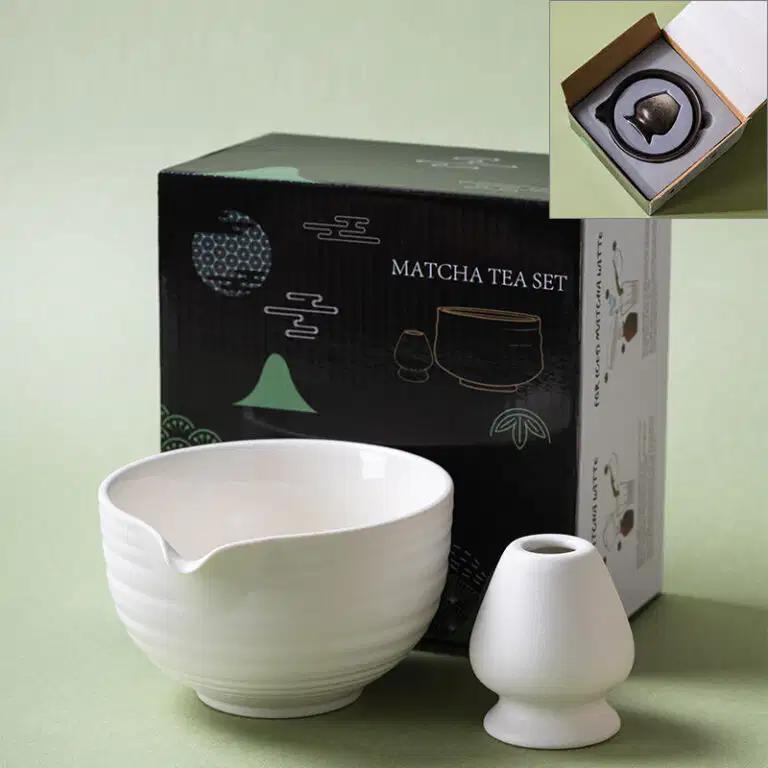
Chasen tate (whisk holder): A ceramic chasen holder in the matching yohen glaze, compact, weighted, and shaped to receive the handle of a standard bamboo chasen. The raised interior dome supports the tines of the whisk from beneath, allowing them to dry in their correct curved position after each use. Using a holder consistently is the single most effective way to extend the life of a quality chasen.
Chasen (bamboo whisk): A 100-tine hand-split bamboo chasen, made from shiro-take (white bamboo) in the craft tradition centred in Takayama, Nara Prefecture. At 100 tines, this is the grade recommended for everyday preparation by both the Urasenke and Omotesenke schools of Japanese tea, fine enough to produce a smooth, even awa (foam) with ease, durable enough for daily use. Arrives in a clear protective storage cylinder that keeps the tines safe between uses.
Chashaku (bamboo scoop): A natural bamboo matcha scoop with a long, gently angled tip, the sui, shaped for precise, clean portioning directly from a natsume or tea caddy. One level scoop measures approximately 1g of matcha, the conventional measure for a bowl of usucha.
Using the set:
Warm the chawan with a small pour of hot water, swirl, and discard. Soak the chasen tines in warm water for 30 seconds before first use. Sift 1–2 chashaku scoops of ceremonial-grade matcha into the warmed bowl. Add 70–80ml of water at 75–80°C and whisk in a brisk W or M motion until a smooth layer of awa forms. Drink directly from the bowl, turning it gently in both hands before the first sip. After use, rinse the chasen under warm water and rest it on the chasen tate to dry. Wipe the chashaku clean with a dry cloth, do not rinse.
Gifting:
This set arrives in our gift packaging, complete and ready to give. It suits anyone beginning a matcha practice as well as those who already prepare matcha daily and are looking to upgrade their tools. The yohen copper-green glaze, warm, complex, and visually connected to the colour of matcha itself — makes it one of the most distinctive colourways in the collection.
Care:
All ceramic pieces: hand wash only, not dishwasher or microwave safe. The yohen glaze will develop a gentle patina with use. Bamboo pieces: wipe clean, do not soak or machine wash.